
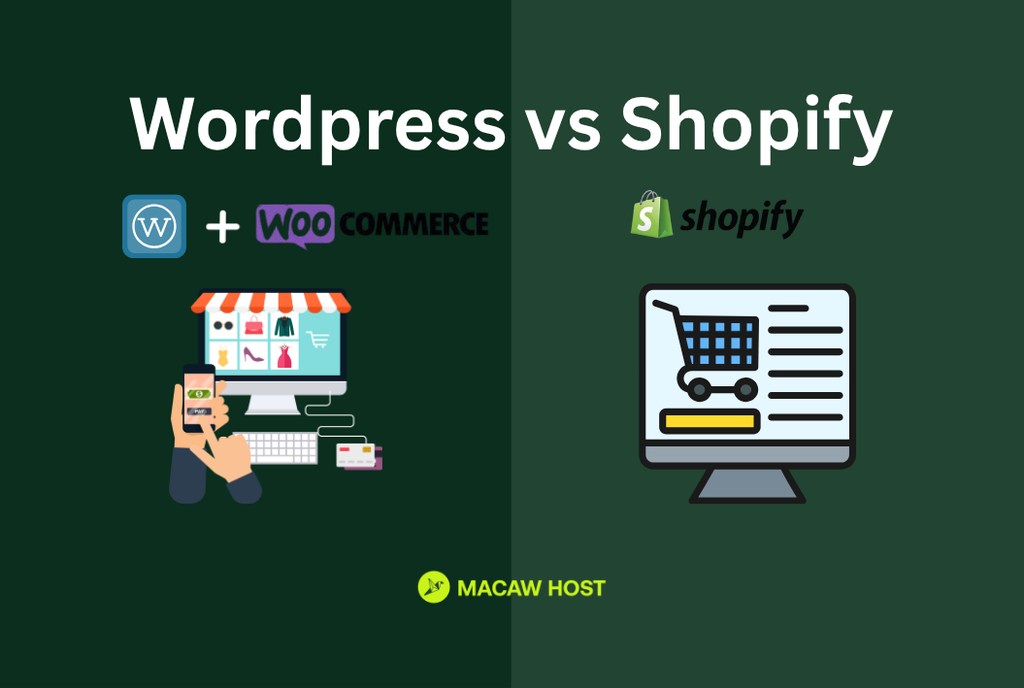
Choosing an e-commerce platform is about more than putting products online. Your platform affects costs, website speed, SEO, checkout flexibility, customer data, integrations, and how easily your business can grow.
For many store owners, the choice comes down to Shopify or WordPress with WooCommerce.
Shopify is a hosted software-as-a-service platform. You pay a recurring subscription, while Shopify handles hosting, much of the security, updates, and core infrastructure. WordPress with WooCommerce works differently: WordPress is open-source software, WooCommerce adds e-commerce features, and with a self-hosted setup, you choose where your store is hosted.
Both can power successful stores. But for businesses that value ownership, customization, cost control, content marketing, and infrastructure choice, self-hosted WordPress and WooCommerce can offer a stronger foundation.
What Does “Self-Hosted E-commerce” Mean?
Self-hosted does not mean keeping a server in your office or becoming a system administrator. It simply means you choose the hosting provider where your WordPress and WooCommerce store runs.
You can start with managed WooCommerce hosting and move to higher-performance infrastructure as traffic grows. WooCommerce highlights this freedom by allowing merchants to choose or change hosts as their needs evolve.
Shopify takes the opposite approach. It includes and manages hosting for you. That is convenient, especially for beginners, but your store remains inside Shopify’s hosted ecosystem.
1. You Get Greater Ownership and Control
The strongest argument for self-hosted e-commerce is control.
WooCommerce is open source and built on WordPress, which is released under the GPL open-source license. WooCommerce says merchants control their checkout, data, costs, payment options, features, and hosting.
That means you can access your database, modify code, move to another host, build custom features, and decide how you configure your infrastructure.
As a business grows, a simple store may need wholesale pricing, subscriptions, multilingual catalogs, ERP integrations, customer portals, or custom checkout rules. An open platform gives you more room to build around those requirements.
This matters because your online store should adapt to your business—not force your business to adapt to the platform’s limitations.
2. You Choose the Hosting That Fits Your Business
A store receiving 1,000 visits a month has different needs from one handling large campaign spikes or customers across several countries.
With WooCommerce, you can choose hosting based on performance, customer support, server location, backups, caching, staging environments, developer tools, or price. If the provider stops meeting your needs, you can migrate.
With Shopify, hosting is included, which removes a major technical decision. That is a real advantage for merchants who do not want to think about servers.
The trade-off is that you cannot simply move your Shopify application to another hosting company because you prefer its infrastructure, pricing, server location, or performance options.
For businesses that expect to scale, the ability to choose and change infrastructure can become strategically valuable.
3. Self-Hosting Can Provide Stronger Cost Control
It would be misleading to say WordPress is always cheaper.
A serious WooCommerce store may pay for premium hosting, extensions, maintenance, security, themes, and development. The difference is how those costs are structured.
WooCommerce’s core platform is free and open source. Its pricing guidance states that there is no platform revenue share, while hosting and additional extensions can be selected separately.
This gives businesses more freedom to decide where to spend their money.
Shopify bundles hosting and platform services into recurring plans. As of September 2026, Shopify’s US pricing page lists annual-billing prices starting at $29 per month for Basic, $79 for Grow, and $299 for Advanced, while Shopify Plus starts at $2,300 per month. Shopify also says additional transaction fees can apply when you use certain third-party payment providers, depending on the plan and market.
That does not mean Shopify is overpriced. You are paying for convenience, managed infrastructure, support, and an integrated platform.
The smarter approach is to compare total cost of ownership.
Consider hosting, apps or plugins, payment processing, development, maintenance, premium themes, international selling tools, staff requirements, and platform fees.
The cheapest solution in month one may not be the cheapest solution in year three.
4. WordPress Is Excellent for Content-Led E-commerce
Modern e-commerce growth depends on much more than product pages.
Online stores attract potential customers through tutorials, buying guides, product comparisons, landing pages, category content, case studies, educational articles, and evergreen SEO pages.
This is an area where WordPress has a natural advantage because content management is at its core.
According to W3Techs data published on September 8, 2026, WordPress powered 40.7% of all websites measured and represented 58.9% of websites using a known content management system.
With WordPress, your e-commerce store and publishing system can work together.
You can create custom content types, detailed landing pages, editorial workflows, internal-linking structures, customized templates, and advanced SEO implementations without forcing every marketing idea into an e-commerce-first website builder.
Shopify also provides blogging and SEO tools, and successful Shopify websites can certainly achieve excellent Google rankings.
The difference is flexibility.
For businesses where organic traffic and content marketing play a major role in customer acquisition, WordPress gives you more freedom to build your content strategy around your business goals.
5. Customization Goes Much Deeper
Shopify has themes, apps, APIs, and impressive customization options. For many businesses, that’s enough.
WooCommerce, however, is designed around extensibility.
You can modify templates, develop custom plugins, connect external applications, change business logic, create specialized customer experiences, or build headless and hybrid e-commerce architectures.
If your store needs B2B quotations, customer-specific pricing, unusual shipping logic, or a product builder connected to internal systems, WooCommerce lets developers build directly around the open platform.
The advantage is simple:
Your technology can adapt to your business instead of forcing your business into a fixed operating model.
This may not matter with 20 products and a simple checkout. It can matter enormously once operations become more complicated.
6. You Have More Payment and Integration Freedom
Payment flexibility can affect both conversion rates and profit margins.
WooCommerce lets merchants choose payment processors and integrate local or specialized payment gateways. WooCommerce itself does not impose a platform revenue share simply because you choose your own processor, although your payment processor will normally charge its own transaction fees.
Shopify also supports third-party payment providers. However, Shopify’s pricing documentation states that additional third-party transaction fees may apply when you don’t use Shopify Payments, depending on your plan and location.
This is especially relevant for international merchants.
You might need a local gateway because customers recognize and trust it, because it supports a particular currency, or because it provides better commercial terms for your business.
With a self-hosted platform, you have more freedom to design your payment infrastructure around the market you serve.
7. Self-Hosting Reduces Platform Lock-In
No e-commerce platform is effortless to leave.
Migrating products, customers, orders, URLs, subscriptions, reviews, integrations, and analytics requires planning whether you use Shopify, WooCommerce, or another solution.
Open-source software still gives you considerably more control over the underlying application and data.
If you outgrow your WooCommerce hosting provider, you can move your website to another provider while keeping WordPress and WooCommerce.
You are changing the infrastructure rather than necessarily changing your entire e-commerce platform.
That portability matters because your technology decision should preserve tomorrow’s options, not only solve today’s problem.
Where Shopify Is Actually Better
Self-hosted e-commerce is not right for everyone.
Shopify is often the better choice for a merchant who wants to launch quickly, avoid hosting management, reduce technical decisions, and use a highly integrated commerce system.
Shopify includes hosting, SSL, commerce tools, customer support, analytics, and a mature checkout experience.
For a small business owner with no technical experience or technical support, that convenience can be extremely valuable.
WooCommerce comes with more responsibility.
Someone needs to manage updates, backups, plugin compatibility, performance, security, and hosting quality. Poor maintenance or too many unnecessary plugins can also create performance, security, and compatibility problems.
So the real question is not:
“Which platform is universally better?”
It is:
“Which operating model fits my business?”
WordPress vs. Shopify: Which Should You Choose?
Choose Shopify if simplicity is your highest priority and you are comfortable operating inside a managed platform.
Choose self-hosted WordPress with WooCommerce if ownership and flexibility matter more.
WooCommerce is particularly attractive for content-driven brands, businesses with unusual technical requirements, companies that want more control over hosting and payment systems, and stores that expect their requirements to become more complicated over time.
That is why self-hosted e-commerce can win in 2026.
The advantage is not that WordPress makes every task easier. It does not.
The advantage is that you retain more choices.
You choose where your store lives. You choose how it is optimized. You choose which systems it connects to. You choose how you structure your content. And you have far more freedom to customize the shopping experience.
For the right business, that freedom becomes a genuine competitive advantage.
Frequently Asked Questions
WordPress with WooCommerce is better when you prioritize ownership, customization, hosting choice, content flexibility, and integration control.
Shopify may be better when you prioritize quick setup, managed infrastructure, simplicity, and lower technical responsibility.
The core WooCommerce platform is free and open source. However, running a professional online store isn’t completely free.
You may still need to pay for hosting, premium extensions, themes, backups, security services, maintenance, development, and payment processing.
For most beginners, yes.
Shopify manages hosting and much of the underlying technical infrastructure, making it easier to launch and maintain.
WordPress and WooCommerce offer significantly more control, but that control also means you have more technical decisions to make.
Both platforms can rank well on Google and other search engines.
WordPress is particularly strong for advanced content strategies because it provides extensive control over publishing, site architecture, templates, metadata, structured content, internal linking, and technical customization.
However, SEO performance ultimately depends on content quality, website performance, backlinks, user experience, technical implementation, and competition—not simply the platform you choose.
Yes.
However, migration requires careful planning. You may need to transfer or rebuild products, customer information, orders, images, URLs, redirects, SEO metadata, subscriptions, reviews, and integrations.
A properly planned migration can greatly reduce the risk of losing search rankings or creating a poor customer experience.
No.
You can use managed WordPress or managed WooCommerce hosting. The hosting provider can handle much of the server administration while you retain the option to move your website elsewhere later.
Final Verdict
Shopify remains one of the strongest hosted e-commerce platforms available, and its convenience is valuable.
But convenience and ownership are not the same thing.
Growing businesses increasingly need adaptable technology, cost control, integrations, powerful content capabilities, and infrastructure that can evolve with them.
A properly hosted and professionally maintained WordPress and WooCommerce store can provide that freedom.
If you want the simplest possible route to start selling online, Shopify deserves serious consideration.
But if you want to build a long-term digital commerce asset that you can host, customize, integrate, optimize, migrate, and evolve on your own terms, self-hosted WordPress and WooCommerce remain one of the most compelling e-commerce choices .