
Choosing the best blogging platform depends on what you want to achieve. Are you starting a personal blog, sharing your writing, or building a website that could eventually become a business?
Some platforms are completely free, while others offer more control and flexibility through paid plans.
In this guide, we’ll compare five popular blogging platforms, their strengths, limitations, and costs to help you find the right fit.
Key Takeaways
- WordPress.org offers the most flexibility for bloggers who want full control over their websites.
- WordPress.com and Wix are beginner-friendly options with free and paid plans.
- Blogger is a simple, free choice for personal blogs.
- Medium is ideal for writers who want to publish without building a complete website.
- Free platforms are convenient, but paid options generally provide more branding and customization choices.
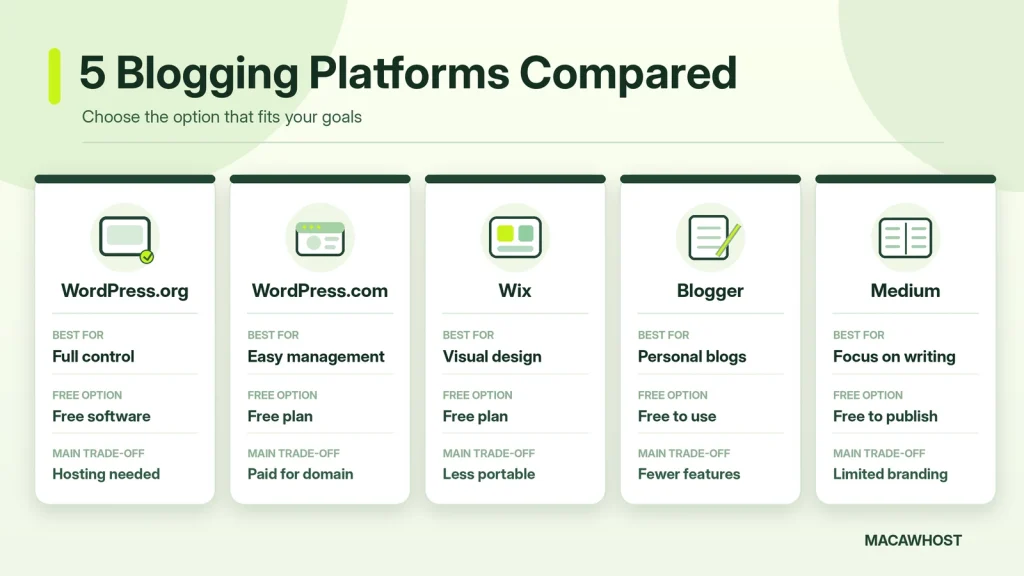
5 Best Blogging Platforms at a Glance
Here’s a quick comparison before we look at each option.
| Platform | Best For | Free Option | Main Limitation |
|---|---|---|---|
| WordPress.org | Long-term blogs and businesses | Free software; hosting costs extra | Requires some maintenance |
| WordPress.com | Beginners wanting managed hosting | Yes | Free plan has restrictions |
| Wix | Visual design and easy setup | Yes | Limited hosting portability |
| Blogger | Personal and hobby blogs | Yes | Basic customization |
| Medium | Writers and thought leaders | Yes | Less website control |
All five let you publish articles, but they differ in how much control you have over design, hosting, and monetization.
1. WordPress.org — Best for Long-Term Growth
WordPress.org is a free, open-source platform that allows you to create and manage your own website.
Unlike hosted blogging services, WordPress.org requires separate web hosting and a domain name.
Advantages:
- Thousands of themes and plugins
- Extensive customization and SEO options
- Flexible monetization opportunities
- Freedom to choose or change hosting providers
Limitations:
- Hosting and domain registration cost money
- Requires updates, backups, and ongoing maintenance
Free or paid? The software is free, but you’ll pay for hosting and typically a domain.
Best for: Bloggers who want to build a professional website, grow their audience, or eventually earn money from their content.
2. WordPress.com — Best for Easy WordPress Blogging
WordPress.com uses WordPress software but includes hosting, security, and maintenance.
You can start with a free blog using a WordPress.com address, such as myblog.wordpress.com.
Advantages:
- Simple setup without separate hosting
- Free plan available
- WordPress editing and publishing tools
- Hosting and software updates handled for you
Limitations:
- Free sites use a WordPress.com subdomain
- Custom domains and plugin installations require a paid plan
Free or paid? Both. The free plan suits basic blogging, while paid plans provide more features.
Best for: Beginners who like WordPress but don’t want to manage their own hosting.
3. Wix — Best for Design and Customization
Wix is an all-in-one website builder with blogging tools and a visual drag-and-drop editor.
You can choose a template, customize your design, and publish articles without coding.
Advantages:
- Easy drag-and-drop website builder
- Large selection of templates
- Hosting included
- Free plan to get started
Limitations:
- Free websites display Wix branding
- A custom domain requires a paid plan
- Moving a Wix website to another hosting provider generally requires rebuilding it
Free or paid? Both. Premium plans unlock custom domains, remove Wix branding, and provide additional features.
Best for: Beginners who prioritize visual design and want an easy website-building experience.
4. Blogger — Best Free Blogging Platform for Personal Blogs
Blogger is Google’s blogging service. It’s a straightforward option for publishing articles without paying for hosting.
You can create a blog using a free blogspot.com address or connect a domain you already own.
Advantages:
- Free blogging and hosting
- Simple writing and publishing tools
- No WordPress installation needed
- Supports custom domains
Limitations:
- Fewer design and customization options
- Limited advanced features compared with WordPress
Free or paid? Blogger itself is free. You’ll only need to pay if you want a separately registered domain or other external services.
Best for: Hobby bloggers and anyone who wants to publish articles without spending money.
5. Medium — Best for Writers Who Want to Focus on Content
Medium is a publishing platform where writers share articles with readers interested in different subjects.
Unlike traditional website builders, Medium focuses on writing and content discovery rather than website design.
Advantages:
- Free to publish articles
- Simple, distraction-free editor
- Potential exposure through Medium’s reader network
- No separate hosting required
Limitations:
- Limited design and branding flexibility
- Less control over the overall website experience
- Custom domains require a paid membership
- Earning through Medium’s Partner Program requires eligibility
Free or paid? Publishing is free. Optional membership unlocks additional benefits.
Best for: Writers, professionals, and people who want to share ideas without building and maintaining a separate website.
How to Choose the Best Blogging Platform
Still unsure which option to choose? Focus on these four questions.
New to blogging? Our blogging for beginners guide walks you through choosing a topic, setting up your website, and publishing your first blog post.
1. What’s Your Blogging Goal?
If you’re writing for fun, Blogger or Medium may be enough.
If you’re building a business, professional brand, or monetized blog, WordPress.org offers more flexibility.
2. What’s Your Budget?
Free platforms are a practical starting point, but they may limit your domain name, branding, or features.
With self-hosted WordPress, you pay for hosting but gain greater control over your website.
Not sure how hosting works? Read our guide on what web hosting is.
3. How Much Control Do You Need?
Think about whether you want custom designs, plugins, advertising, ecommerce, or advanced SEO features.
WordPress.org offers extensive flexibility. Wix and WordPress.com make website management simpler, while Blogger and Medium focus more on straightforward publishing.
4. Do You Want Your Own Domain?
A custom domain helps establish a recognizable website address, such as yourblog.com.
Some free platforms use branded subdomains unless you upgrade or connect a purchased domain.
Our guide to what a domain name is explains how to choose and register one.
Free vs Paid Blogging Platforms: Which Should You Choose?
A free platform can be enough when you’re experimenting or blogging as a hobby.
A paid option becomes worth considering when you need a custom domain, more features, or greater control over your website.
Choose free blogging if: You want to practice writing, publish personal stories, or test your ideas without a financial commitment.
Choose paid blogging if: You want to develop a professional brand, customize your website extensively, or create a business around your content.
Remember to compare renewal costs, storage limits, and available features before committing to any platform.
Which Blogging Platform Is Right for You?
The best blogging platform is the one that matches your goals and gives you room to grow.
For a simple personal blog, Blogger or Medium can be enough. If you want visual design tools without managing hosting, Wix or WordPress.com are practical choices.
For bloggers planning to build a long-term website, WordPress.org is our preferred option because of its flexibility, plugin ecosystem, and hosting freedom.
If you choose self-hosted WordPress, MacawHost WordPress Hosting offers one-click WordPress installation, free SSL, automatic daily backups, and a free domain for the first year on eligible plans.
Start with the platform that fits your needs today, and focus on creating content your readers will find useful.